Guide
Choosing a bedside clock
Four things decide whether a bedside clock suits you: its light, where the time shows, its sound and what it does in a power cut.

Light
How bright, and what color
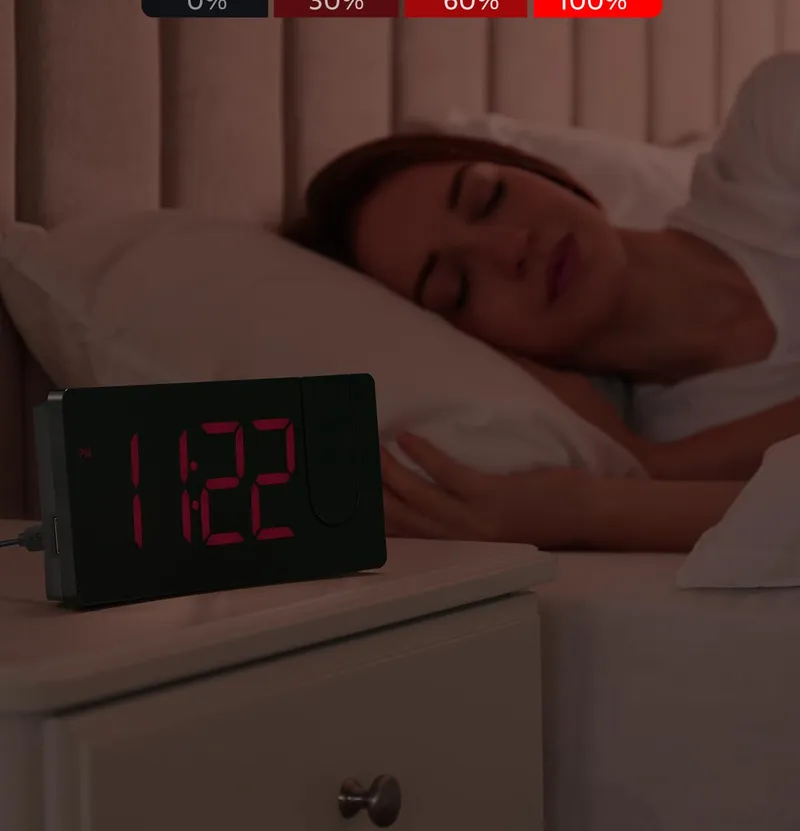
A clock is a light that stays on all night. So the first question is how far you can turn it down.
The National Institute of General Medical Sciences puts light first among the things that set the body clock: Light and dark have the biggest influence on circadian rhythms, but food intake, stress, physical activity, social environment, and temperature also affect them.
National Institute of General Medical Sciences (NIH)
It adds a warning about screens: Light from electronic devices at night can confuse biological clocks.
National Institute of General Medical Sciences (NIH)
On color, a NIOSH training course for nurses on shift work says: Blue light has the strongest impact on circadian rhythms.
National Institute for Occupational Safety and Health (CDC) About the receptors in the eye that carry this signal, the same course says: These photoreceptors do not respond to red light and minimally respond to yellow and orange light.
National Institute for Occupational Safety and Health (CDC)
For the bedroom itself, the National Heart, Lung, and Blood Institute gives one line of advice: Keep your bedroom quiet, cool, and dark (a dim night light is fine, if needed).
National Heart, Lung, and Blood Institute (NIH)
These sources are about light and sleep in general, not about any clock. None of them tested a GOLOZA product. What a clock can offer is control: more brightness levels, an off setting, and a choice of digit color.
Dimming on GOLOZA clocks
| Model | Brightness levels | Screen off | Dims by itself |
|---|---|---|---|
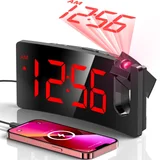
| Projection Alarm Clock | 3 | Yes | No |
| Curved Digital Alarm Clock | 5 | Yes | Yes, night mode on a schedule |
| 7-Inch Talking Day Clock | 10 | No | Yes, auto dimmer with night hours |
Red, blue, green and white digits are on sale across the projection clock and the curved clock. If light at night bothers you, start with the lowest level, whatever the color.
Where the time shows
On the screen or on the ceiling
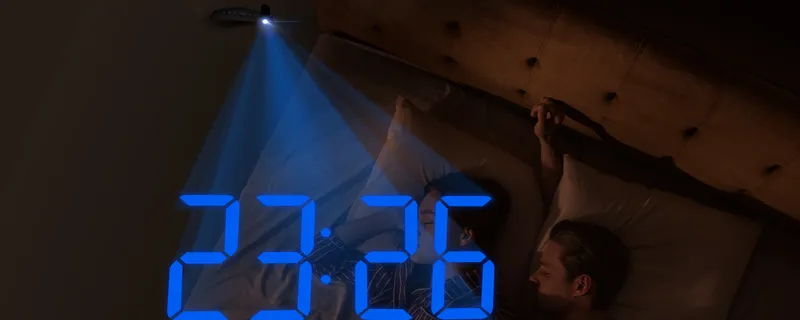
A screen clock asks you to turn your head. A projection clock puts the time on the wall or ceiling, where a person lying on their back already looks. The Projection Alarm Clock does both, and each can be dimmed or switched off apart from the other.
Projection suits you if
- You wake at night and want the time without moving.
- You take your glasses off to sleep and cannot read a small screen from the pillow.
- You want the screen dark and the time still in view.
Skip projection if
- Any light on the ceiling keeps you awake. One buyer found the lowest level too bright.
- The clock will sit more than 11.4 feet from the wall or ceiling.
- You share the room with someone who wants full darkness.
Sound
How you want to be woken
Alarm sound is a matter of habit. A heavy sleeper wants volume. A light sleeper wants a soft start.
A steady routine matters more than the sound. NHLBI lists it first among its sleep habits: Go to bed and wake up at the same time every day.
National Heart, Lung, and Blood Institute (NIH)
| Model | Alarm sound | Volume | Snooze |
|---|---|---|---|
| Projection Alarm Clock | Buzzer that gets louder and faster | Up to 75 dB | 9 minutes |
| Curved Digital Alarm Clock | Birdsong, beep or chord | 2 levels, 75 to 85 dB | 9 minutes |
| 7-Inch Talking Day Clock | 2 ringtones, spoken time, hourly chime | 10 levels | No |
Power
What happens in a power cut
Ask this before you buy any corded clock.
The clock goes dark
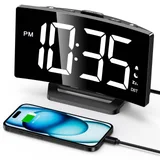
GOLOZA clocks run from the wall. Without power the screen is off.
The alarm stays silent
The battery inside does not sound the alarm. A phone or a battery clock is the backup for an early flight.
The settings survive
When power returns, the time and the alarm are still set. There is nothing to enter again.
Size
How large the digits are
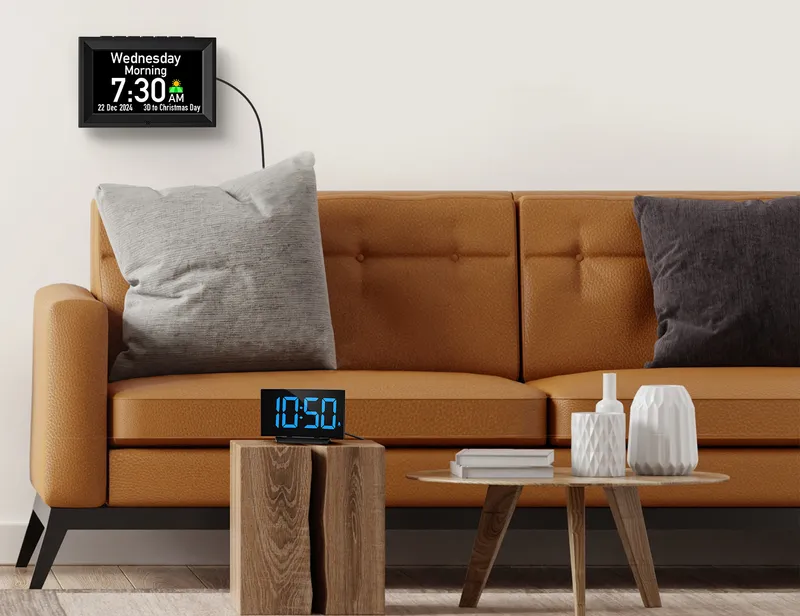
Product descriptions give sizes, and sizes are easy to compare. The projection clock has digits 3.4 by 1.7 inches on a body 6.9 inches wide. The curved clock is 5.05 inches wide. The day clock has a 7-inch screen in a frame 7.7 inches wide.
No GOLOZA product description gives a reading distance. For a small nightstand, measure the free space first. For a living room wall, the 7-inch day clock is the only GOLOZA model built to hang.
In short
Better choice when
Projection clock
You check the time at night and want it on the ceiling. $16.99.
Curved clock
You want a small clock that dims on a schedule and a choice of alarm tone. $15.98.
Day clock
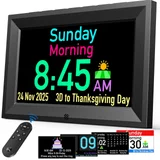
The reader needs the day, the date and a spoken time more than an alarm. $30.99.
Your phone
You travel, or you need an alarm that still sounds when the power is out.
General information for shoppers, not medical advice. If you sleep badly for weeks, talk to a doctor.
Questions
Light, sound and sleep
What color clock light is best for a bedroom at night?
NIOSH states that blue light has the strongest effect on the body clock and that the eye’s receptors do not respond to red light. The projection clock comes with red digits and 3 dimming levels.
Should a bedside clock be dimmable?
Yes, if light bothers you. NHLBI advises a dark bedroom and allows a dim night light. All 3 GOLOZA models dim, and 2 of them can turn the screen off.
Sources
- Circadian RhythmsNational Institute of General Medical Sciences (NIH) · read 12 October 2026
- The Color of the Light Affects Circadian RhythmsNational Institute for Occupational Safety and Health (CDC) · read 12 October 2026
- Healthy Sleep HabitsNational Heart, Lung, and Blood Institute (NIH) · read 12 October 2026
Next
Keep going
Compare the clocks
Three models, row by row.
First setup
Plug in, set the time, set the alarm.
All GOLOZA clocks
Every model and digit color with its price.